Insights · A series in six parts
Economic Boom and
Baby Bust in Georgia
We often hear that Georgia is doing well: the economy is growing fast and wages are rising. Since 2014, real GDP has grown by more than 80%, and over the last five years by about 9% a year, partly a rebound from 2020.Growth like this is usually expected to make it easier to start a family. In Georgia, the opposite has happened. Births have fallen for eleven years in a row, weddings are down by almost a third, and two in three young adults say they would leave for a while if they had the chance.So have Georgians stopped wanting to marry and have children? Or are there reasons that make them wait: a steady job, a home they can afford and a future clear enough to plan a family around?
Georgia, 2014-2025
As Georgia grew richer, it had fewer babies every year
Each dot is one year, 2014 to 2025
At a glance
The puzzle in numbers
The charts below set the economy beside family life. Since 2014, the year births peaked, real GDP has grown every year except 2020 and is now 84% larger. Over the same period, weddings per 1,000 people dropped by a third, women married 3.5 years older on average and became mothers almost three years later, and births fell by 38%. These are the starting facts. The analysis that follows tries to explain them through an economic lens: it asks what drives these decisions, not whether they are right or wrong.
Georgia, 2005-2025
The series
A family-oriented country with fewer families
Georgia lies in the South Caucasus, between the Black Sea and the Caspian Sea, with Russia to the north and Türkiye, Armenia and Azerbaijan to the south. Family traditions are strong across the region, and Georgia is no exception. In 2014, the year births peaked, 98 in every 100 Georgian adults told the World Values Survey that family was very important in their life, compared with 92 in 100 across the 59 other countries in that round of the survey (Inglehart et al., 2014). However, births have fallen every year since, eleven years in a row, and there is no single reason for it.
Families start later, weddings wait for a job and a home, young people leave or want to leave, and the skills they take with them are never counted. Each of these problems has its own causes and its own costs, and when they are told all at once, they blur together. The series therefore examines them one at a time. Each part isolates a single problem, sets out what the data show, considers why it arises, and estimates what it costs the country.
Before you start
From the Soviet Union to today
Until 1991, Georgia was one of the fifteen republics of the Soviet Union. It declared independence on 9 April 1991, so the series begins there and describes Georgia as an independent state; the comparable yearly data on births start a little later, in 1994. For a short overview of the years since, it is worth singling out a few events, because they shaped the country directly: both its internal development and its international position. Decisions about marriage and children are never made in isolation. Each of these events changed living conditions, or the outlook for them, and with it how certain the future looked. That is exactly what young couples weigh before they start a family.
State symbols
-

Until 1990
Soviet Georgia
The Georgian Soviet Socialist Republic, one of the fifteen republics of the Soviet Union.

-
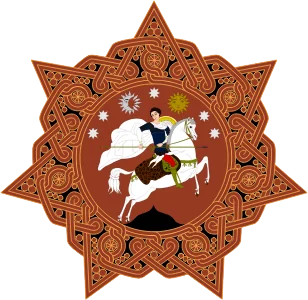
1990-2004
Independence
The flag and coat of arms of the 1918-1921 Democratic Republic of Georgia, restored.

-
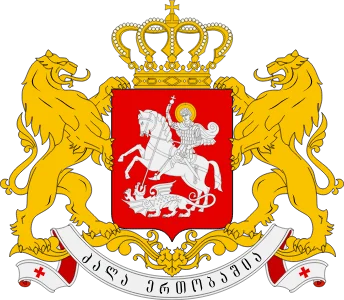
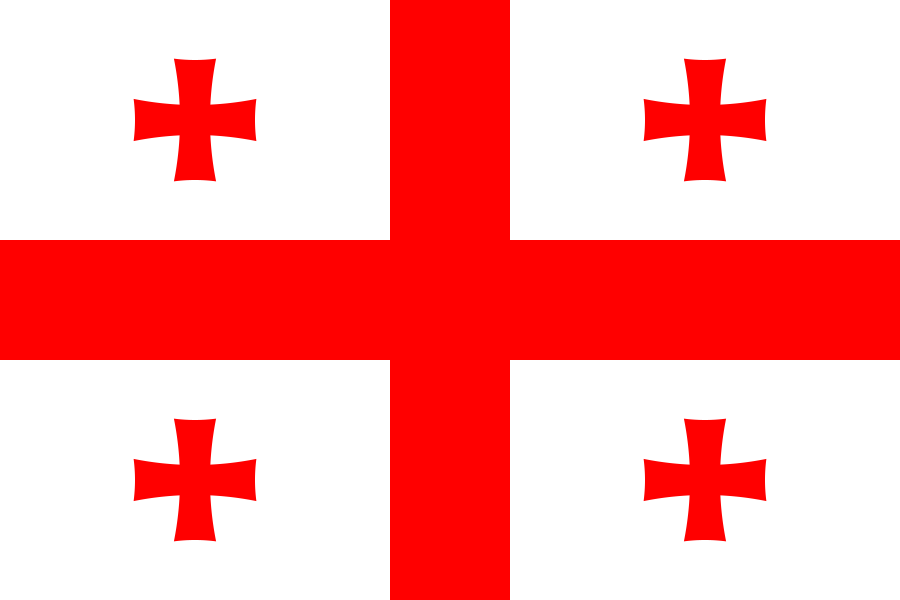
Since 2004
Georgia today
The five-cross flag and the coat of arms with Saint George.
Contents
-
01
The families that never start
After eleven years of decline, births in Georgia hit a record low in 2025: 22,768 fewer babies than in 2014. Most of the missing are first babies.
About 5 min
-
02
Two kinds of waiting
Not all waiting is bad news. Waiting to marry can mean a degree and a career, or a fear of what comes next, and in the statistics the two look the same.
About 6 min
-
03
The missing foundations
Waiting makes sense when the future is unclear. For young Georgians, the uncertainty has three sources.
About 5 min
-
04
A door that never closes
From 2012 to 2023, more Georgians left than came back in every year but one, with a record in 2023. Since 2024 the flow has turned, yet the wish to leave has hardly changed.
About 3 min
-
05
The hidden part of the brain drain iceberg
The statistics see only the tip of the iceberg: the money emigrants send home. What skilled emigrants take with them stays below the surface.
About 3 min
-
06
Can the baby bust end?
Low fertility is a world trend and emigration is the post-Soviet story. In Georgia, the registered fall in fertility is among the fastest, and the Baltic states show that emigration can turn.
About 6 min
References
- Act of Restoration of State Independence of Georgia (1991, April 9). Supreme Council of the Republic of Georgia. Retrieved November 3, 2026, from https://matsne.gov.ge/en/document/view/32362Independence on 9 April 1991 (series home and the timeline).
- Association Agreement between the European Union and the European Atomic Energy Community and their Member States, of the one part, and Georgia, of the other part. (2014). Official Journal of the European Union, L 261, 30 August 2014, 4. http://data.europa.eu/eli/agree_internation/2014/494/ojThe Association Agreement with the EU, signed on 27 June 2014 (timeline, 2014).
- Bernanke, B. S. (1983). Irreversibility, uncertainty, and cyclical investment. The Quarterly Journal of Economics, 98(1), 85-106. https://doi.org/10.2307/1885568The option value of waiting (Part 2).
- Cabral, A. R. (2026, September 17). Trump Organisation to build 62-storey 'ultra-luxury' tower in Georgia. The National. https://www.thenationalnews.com/business/property/2026/09/17/trump-organisation-to-build-62-storey-ultra-luxury-tower-in-georgia/The launch of Trump Tower Tbilisi in September 2026 and its starting prices (Part 3, housing box).
- Central bank sells USD 20m, ninth intervention in 2015. (2015, December 24). Civil.ge. https://civil.ge/archives/125201About 64% of loans in Georgia were in foreign currency, mostly US dollars (timeline, 2015).
- Chung, S.-H., Deopa, N., Saxena, K., & Stone, L. (2025). Religiously inspired baby boom: Evidence from Georgia. Journal of Population Economics, 38(1), Article 34. https://doi.org/10.1007/s00148-025-01092-5The church baptism campaign and births: a large rise in third and later births within marriage, together with more marriages (Part 1 and the timeline).
- Commission Implementing Regulation (EU) 2026/496 of 6 March 2026 on the temporary suspension of the exemption from the visa requirement for nationals of Georgia holding diplomatic passports and service or official passports. (2026). Official Journal of the European Union, L series, 2026/496, 6 March 2026. https://eur-lex.europa.eu/eli/reg_impl/2026/496/oj/engVisa-free travel suspended for holders of Georgian diplomatic, service and official passports, and the possible extension to all Georgian citizens (Part 3 and the timeline).
- Committee on the Rights of the Child. (2017). Concluding observations on the fourth periodic report of Georgia (CRC/C/GEO/CO/4). United Nations. https://tbinternet.ohchr.org/_layouts/15/treatybodyexternal/Download.aspx?symbolno=CRC%2FC%2FGEO%2FCO%2F4&Lang=enThe Civil Code revision of December 2015 that set the minimum age for marriage at 18 without exceptions, in force by 1 January 2017 (Part 2 and the timeline).
- Constitution of Georgia, art. 78 (1995, as amended by Constitutional Law No. 1324 of 13 October 2017 and No. 2071 of 23 March 2018). https://matsne.gov.ge/en/document/view/30346Article 78 on integration into European and Euro-Atlantic structures (Part 3).
- Council of the European Union. (n.d.). Georgia. Retrieved October 30, 2026, from https://www.consilium.europa.eu/en/policies/georgia/EU candidate status, December 2023.
- CRRC Georgia. (2019). Caucasus Barometer 2019 Georgia [Data set]. https://caucasusbarometer.org/en/cb2019ge/Questions on leaving for a while (MIGSHRT) and for good (EMIGRAT).
- CRRC Georgia. (2024). Caucasus Barometer 2024 Georgia [Data set]. https://caucasusbarometer.org/en/cb2024ge/The same two questions in 2024 (MIGSHRT, EMIGRAT), by age and education (Part 4), and support for EU membership (EUSUPP, Part 3).
- Dixit, A. K., & Pindyck, R. S. (1994). Investment under uncertainty. Princeton University Press. https://doi.org/10.1515/9781400830176The option value of waiting (Part 2).
- Espenshade, T. J., Guzman, J. C., & Westoff, C. F. (2003). The surprising global variation in replacement fertility. Population Research and Policy Review, 22(5-6), 575-583. https://doi.org/10.1023/B:POPU.0000020882.29684.8eWhy replacement fertility is about 2.1 only where few children die young (Part 6).
- European Commission. (2026, March 6). Commission suspends visa-free travel for Georgian holders of diplomatic, service or official passports [Press release]. Delegation of the European Union to Georgia. https://www.eeas.europa.eu/delegations/georgia/commission-suspends-visa-free-travel-georgian-holders-diplomatic-service-or-official-passports-under_enThe suspension, and that the Commission can extend it to all Georgian citizens (Part 3 and the timeline).
- European Parliament. (2024, November 28). Resolution of 28 November 2024 on Georgia's worsening democratic crisis following the recent parliamentary elections and alleged electoral fraud (P10_TA(2024)0054). https://data.europarl.europa.eu/distribution/doc/TA-10-2024-0054_en.pdfThe European Parliament's view that the October 2024 election cannot be considered free and fair (Part 3).
- Eurostat. (2026a). First permits by reason, length of validity and citizenship (migr_resfirst) [Data set]. https://doi.org/10.2908/MIGR_RESFIRSTEU work and residence permits issued to Georgians (Part 4).
- Eurostat. (2026b). Marriage indicators (demo_nind) [Data set]. https://doi.org/10.2908/DEMO_NINDEU-27 crude marriage rate, 1994-2024 (Part 2, marriage chart), and women's mean age at first marriage in EU countries, 2024 (Part 2). Downloaded 3 November 2026.
- Galt & Taggart. (2026, February 27). Tbilisi residential real estate: January 2026 update [Market report]. https://ramad.bog.ge/galt/SYqIy0tX-Tbilisi-Residential-Real-Estate_ENG_Jan-2026.pdfAverage price of new flats (primary market) in Tbilisi, January 2026: US$1,385 per m² (Part 3, housing box).
- Gauthier, A. H. (2007). The impact of family policies on fertility in industrialized countries: A review of the literature. Population Research and Policy Review, 26(3), 323-346. https://doi.org/10.1007/s11113-007-9033-xWhat family policy can and cannot do for births (Part 6).
- geoBoundaries. (n.d.). Georgia: First-level administrative divisions (ADM1) [Data set; CC BY 3.0]. Retrieved October 2026, from https://www.geoboundaries.org/api/current/gbOpen/GEO/ADM1/Region outlines on the maps.
- Georgia reintroduces restrictions as COVID-19 cases spike. (2020, September 9). Civil.ge. https://civil.ge/archives/366320The ban on weddings and other large social events in 2020 (Part 2, marriage chart, and the timeline).
- Georgian kuponi. (2026). In Wikipedia. Retrieved November 3, 2026, from https://en.wikipedia.org/wiki/Georgian_kuponiThe coupon (1993-1995) and its replacement by the lari at one million to one (Part 1).
- How the war in Ukraine affects the real estate market in Georgia. (2022, November 28). JAMnews. https://jam-news.net/how-the-war-in-ukraine-affects-the-real-estate-market-in-georgia/Arrivals from Russia in 2022 and the jump in Tbilisi rents (Part 2, marriage chart, and the timeline).
- Human Rights Watch. (2025). World report 2025: Georgia. https://www.hrw.org/world-report/2025/country-chapters/georgiaEvents of 2024: the "foreign influence" law and the spring protests, the disputed October election, and the decision to put EU accession talks on hold until 2028 (Part 3 and the timeline).
- Human Rights Watch. (2026). World report 2026: Georgia. https://www.hrw.org/world-report/2026/country-chapters/georgiaEvents of 2025: the "foreign agents" law, the new rules on protests and the media, and the protests through 2025 (Part 3).
- Inglehart, R., Haerpfer, C., Moreno, A., Welzel, C., Kizilova, K., Diez-Medrano, J., Lagos, M., Norris, P., Ponarin, E., & Puranen, B. (Eds.). (2014). World Values Survey: Round six, country-pooled datafile version [Data set]. JD Systems Institute. https://www.worldvaluessurvey.org/WVSDocumentationWV6.jspHow many people say family is very important in their life, in Georgia and in the 59 other countries of the round (series home). The results can be checked in the WVS Online Analysis and in the IHSN catalog (all countries, Georgia 2014).
- Internal Displacement Monitoring Centre. (2018). Georgia: Conflict displacement figure analysis (Global Report on Internal Displacement 2018). https://www.ecoi.net/en/file/local/2008385/GRID+2018+-+Figure+Analysis+-+GEORGIA.pdfThe wars of the early 1990s and the hundreds of thousands of displaced people (timeline).
- Kuczynski, R. R. (1928). The balance of births and deaths: Vol. 1. Western and Northern Europe. Macmillan. https://catalog.hathitrust.org/Record/001888197The net reproduction rate: whether one generation replaces the next (Part 6).
- Lanchava, L. (2014). Does religious activity affect childbearing decisions? The case of Georgia (CERGE-EI Working Paper No. 521). CERGE-EI. https://www.cerge-ei.cz/pdf/wp/Wp521.pdfThe Patriarch's announcement in October 2007, and a study that finds no clear effect on births (Part 1 and the timeline).
- Langford, C. M. (2003). Kuczynski, R. R. In P. Demeny & G. McNicoll (Eds.), Encyclopedia of population. Macmillan Reference USA. Retrieved November 3, 2026, from Encyclopedia.com: https://www.encyclopedia.com/social-sciences/encyclopedias-almanacs-transcripts-and-maps/kuczynski-r-rKuczynski attributed the net reproduction rate to Richard Böckh of Berlin and made it popular (Part 6).
- Meade, J. E. (1952). External economies and diseconomies in a competitive situation. The Economic Journal, 62(245), 54-67. https://doi.org/10.2307/2227173The beekeeper and the orchard (Part 5).
- National Bank of Georgia. (2026a). Official exchange rates of the Georgian lari [Data set]. https://nbg.gov.ge/en/monetary-policy/currencyLari to US dollar, for the housing box, and the fall of the lari in 2015 (Part 2 and the timeline).
- National Bank of Georgia. (2026b). Statistics data: Interest rates [Data set]. https://nbg.gov.ge/en/statistics/statistics-dataInterest rates on new loans, to check the mortgage rate.
- National Statistics Office of Georgia. (2026a, June 22). Main results of the 2024 population and agricultural census. https://geostat.ge/media/80541/Main-Results-of-the-2024-Population-and-Agricultural-Census.pdfPopulation change by municipality, 2014-2024 (Part 1).
- National Statistics Office of Georgia. (2026b). Population and demography [Data set]. https://www.geostat.ge/en/modules/categories/41/populationThe yearly Excel tables behind most charts: births (total, by order, by age of mother), fertility rate, age of mothers and of spouses, marriages, divorces, population by age, migration by age and by citizenship, and the acquisition and loss of Georgian citizenship (data of the Public Service Development Agency).
- National Statistics Office of Georgia. (2026c, March 27). Summary of vital statistics 2025. https://geostat.ge/media/77836/SUMMARY-OF-VITAL-STATISTICS---2025.pdfBirths, marriages and divorces in 2025 (37,867 births).
- National Statistics Office of Georgia. (2026d). Wages [Data set]. https://www.geostat.ge/en/modules/categories/39Average monthly nominal earnings of employees, second quarter of 2026: the average gross salary in Part 3, housing box.
- Natural Earth. (2022). 1:50m cultural vectors: Admin 0, countries (Version 5.1.2) [Data set]. https://www.naturalearthdata.com/downloads/50m-cultural-vectors/50m-admin-0-countries-2/Neighbouring countries on the locator map.
- OpenStreetMap contributors. (2026). Abkhazia (relation 1152720) and Tskhinvali region (relation 1152717) [Data set; ODbL]. https://www.openstreetmap.org/relation/1152720, https://www.openstreetmap.org/relation/1152717Outlines of the occupied territories on the maps.
- Organic Law of Georgia on Georgian Citizenship, arts. 3, 21, 21¹, 24 (2014, as amended). Retrieved November 3, 2026, from https://matsne.gov.ge/en/document/view/2342552A Georgian who acquires another citizenship loses Georgian citizenship unless the President consents in advance (Part 6).
- Razmadze, M. (2026, April 27). Mortgage lending surges in Georgia in Q1 2026. Georgia Today. https://georgiatoday.ge/mortgage-lending-surges-in-georgia-in-q1-2026/Average interest rate on new mortgages in lari, March 2026, from National Bank of Georgia data (Part 3, housing box).
- Regulation (EU) 2017/372 of the European Parliament and of the Council of 1 March 2017 amending Regulation (EC) No 539/2001 listing the third countries whose nationals must be in possession of visas when crossing the external borders and those whose nationals are exempt from that requirement (Georgia). (2017). Official Journal of the European Union, L 61, 8 March 2017, 7. http://data.europa.eu/eli/reg/2017/372/ojVisa-free travel to the Schengen area from 28 March 2017 (Part 4 and the timeline).
- Trump Tower Tbilisi debuts as Georgia's tallest building in $2bn development. (2026). Gulf Business. https://gulfbusiness.com/en/2026/real-estate/trump-tower-tbilisi-debuts-as-georgias-tallest-building-in-2bn-development/Trump Tower Tbilisi: asking prices (Part 3).
- Tsion, H. (n.d.). From Israel to Georgia: The developer behind Tbilisi's new Trump Tower. Ynetnews. Retrieved November 3, 2026, from https://www.ynetnews.com/real-estate/article/bjgibzetzgTrump Tower Tbilisi: asking prices, expected buyers and the developer's expectation of up to $15,000 per m² (Part 3).
- Wikidata contributors. (2026). Settlements of Georgia: 2014 census population, coordinates and elevation [Data set]. Retrieved October 2026, from the Wikidata Query Service, https://query.wikidata.orgTowns and villages on the missing-babies map (Part 1).
- Will Soviet period bank accounts be restored? (2013, March 1). The Messenger. https://messenger.com.ge/issues/2809_march_1_2013/2809_econ_two.htmlGeorgians lost Soviet-era savings; compensation in 1997-1998 was partial and stopped (Part 1).
- World Bank. (2012). Fighting corruption in public services: Chronicling Georgia's reforms. World Bank. https://openknowledge.worldbank.org/handle/10986/2234The reforms after the Rose Revolution of November 2003 (Part 1 and the timeline).
- World Bank. (2026). World development indicators [Data set]. https://databank.worldbank.org/source/world-development-indicatorsReal GDP (NY.GDP.MKTP.KD), including its fall by more than half in the early 1990s, and its yearly growth (NY.GDP.MKTP.KD.ZG); for the comparisons with other countries, fertility (SP.DYN.TFRT.IN), population (SP.POP.TOTL), net migration (SM.POP.NETM), income per person at PPP (NY.GDP.PCAP.PP.CD), remittances (BX.TRF.PWKR.DT.GD.ZS), youth unemployment (SL.UEM.1524.ZS), unemployment at all ages (SL.UEM.TOTL.ZS), vulnerable employment (SL.EMP.VULN.ZS), young people not in education, employment or training (SL.UEM.NEET.ZS) and women's university enrolment (SE.TER.ENRR.FE).